

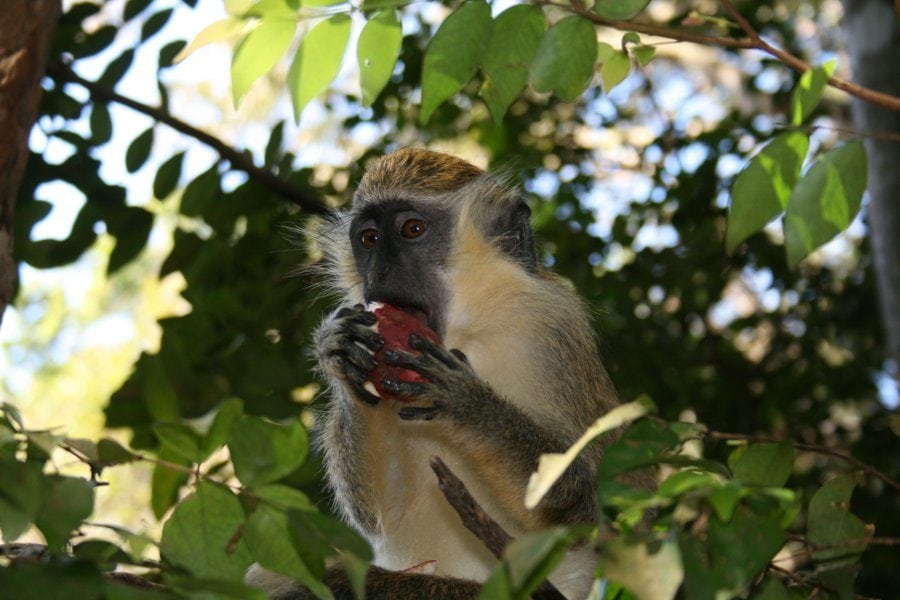
One of Barbados’ most famous residents is the green monkey, and you’re bound to see at least one during your time on the island.
They can be legitimately called the Barbados green monkey because you won’t find them naturally existing anywhere else in the world and they are in fact, funnily enough, green in color.
Did You Know?
The green monkey was initially brought over to Barbados as a pet from regions of West Africa during the slave trade over 350 years ago. Many monkeys then escaped or were released and became ‘naturalized’ in Barbados.
As time passed, the green monkeys adapted to their new environment and evolved to display a different set of characteristics to their first West African relatives; making these monkeys uniquely Bajan.
The green monkey has a thick coat of fur, which is brownish grey. However, these monkeys also have highlights of yellow and green, making their overall appearance look green in color.
You may notice the baby monkeys tend to appear blue. The reason for this is because it takes quite a while for their thick fur to grow through and cover their flesh.
The female green monkeys are very maternal. You may see them around the island carrying their babies attached to their bellies or chest, covered by one protective arm. The male monkeys do not take part in the raising of the babies however other female monkeys in the group share the load with the first mother monkey.
The babies are weaned from their mothers at about six months old and are considered fully matured at between 4 to 5 years of age.
Where Can I See A Green Monkey?
One of the best places to see the Barbados green monkeys in their natural habitat is while sightseeing at the Barbados Wildlife Reserve.
Green monkeys are rampant island-wide but more so as you move further from the towns and busy areas.
Because the Barbados green monkey is naturally inquisitive, you will often find them appear in countryside areas, peering out from in tree canopies, intrigued by any human presence. They are also notoriously cheeky animals and will come up as close to you as they possibly can, without interfering with you.
However, the green monkey poses a severe threat to the agriculture of Barbados. They are infamous for picking at crops, especially fruit. They are renowned for stealing a piece of fruit, taking one bite and then discarding it for a new taste. In fact, many farmers consider the green monkey to be a ‘pest’ as they very quickly make their way through entire crops and destroy everything.
Farmers take certain precautions from the green monkeys as they do prove to be destructive to valuable crops and can sometimes behave aggressively. They are famous for antagonizing dogs and breaking license plates, but, like most animals, if you don’t trouble them, they won’t bother you. They will only lash out if they feel threatened in any way.
Tip: Keep your camera handy – the wild green monkeys make an excellent holiday snapshot and memories to last a lifetime.
Author: Brett Callaghan
