The Freedom Fighter
Bussa – National Hero of Barbados – The Freedom Fighter
Although not much is known about the man, Bussa was born free in West Africa.
No biographical information is available about Bussa; his actual birth name remains a mystery, as does most of his life.
What is known is that African slave merchants captured him in the late 18th century, sold him to the British, then transported him as a slave to Barbados.
What is also known is that Bussa had the strength of character and a passion for enforcing change. This courage and sheer determination are recorded in the history books.
The man Barbadians fondly remember as ‘Bussa’ played an integral role in changing the social and political climate of the island forever.
Note: Existing records show an enslaved person called ‘Bussa’ who worked on a plantation in St. Philip during his rebellion.
The Revolts
‘Bussa’s Rebellion,’ as it is known, was the first of three large-scale slave rebellions in the British West Indies in the years leading up to emancipation. It was followed by the massive revolution in 1823 in Demerara (now part of Guyana) and an even more massive rebellion in 1831 – 1832 in Jamaica.
Did you know?
This group of rebellions is known as the ‘late slave rebellions.’
The revolts arose when the British Parliament was working to improve the conditions of Caribbean enslaved people. The House of Assembly discussed and rejected the Bill, which would have registered colonial enslaved people, and hence Bussa’s historical rebellion began soon after.
Bussa’s Rebellion
On 14 April 1816, Bussa led a large-scale revolt against the Barbadian elitist ‘plantocracy.’
This resulted in a tremendous battle between the enslaved people, the planters, and the West India Regiment (a part of the British Army), significantly impacting Barbados’s historical development.
It was the most massive slave revolt in Barbadian history, lasting two days, whereby hundreds of enslaved people rose in rebellion under the leadership of Bussa.
The planning was undertaken at several sugar estates. Among his collaborators were Washington Franklin, John, and Nanny Grigg, a senior domestic enslaved person, as well as many other enslaved people and black revolutionaries.
Carefully executed by approximately four hundred enslaved people (400), the Bussa Rebellion was geared towards overthrowing the white planter class to regain freedom, restructure the island’s politics, and create a better life for black and people of color.
Bussa was killed in the revolt battle and forced into submission by the Regiment, who had an armory of superior weapons at their disposal. Fifty enslaved people died in the struggle, and seventy were executed in the field.
Note: Another three hundred were taken to Bridgetown for trial – one hundred and forty-four (144) were executed, and one hundred and thirty-two (132) were sent away to another island.
This slave rebellion is documented as the most significant revolt in the history of Barbados.
Bussa’s Legacy Lives On
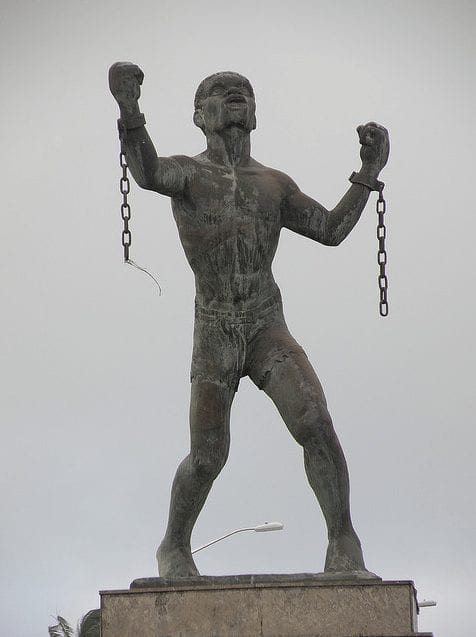
In 1985 (169 years after the revolt), a giant bronze statue, the ‘Emancipation Statue,’ was erected on a roundabout on the ABC Highway in Barbados in honor of Bussa.
The statue represents an enslaved person breaking free from chains, symbolizing the strength of emancipation, and is a nod to the courageous freedom fighter, now a Barbadian household name.
In 1998, by an act of Parliament, Bussa was again publicly honored by being named as one of the ten official National Heroes of Barbados for his significant contribution to the island’s history and development.
This influential and historical figure in Barbadian history represents emancipation and freedom to many, and his legacy will live on in the hearts and minds of Barbadians for generations to come.
Related Articles
